12.4 kW Solar + Battery in Weston, FL

A 12.4 kW rooftop solar and battery system designed, permitted, and installed by Sprightful for Weston homeowners. Energized September 2016.

System size
12.4kW
44 modules
Battery
13.5kWh
Tesla Powerwall 3
Permit → energize
56days
14d in permitting

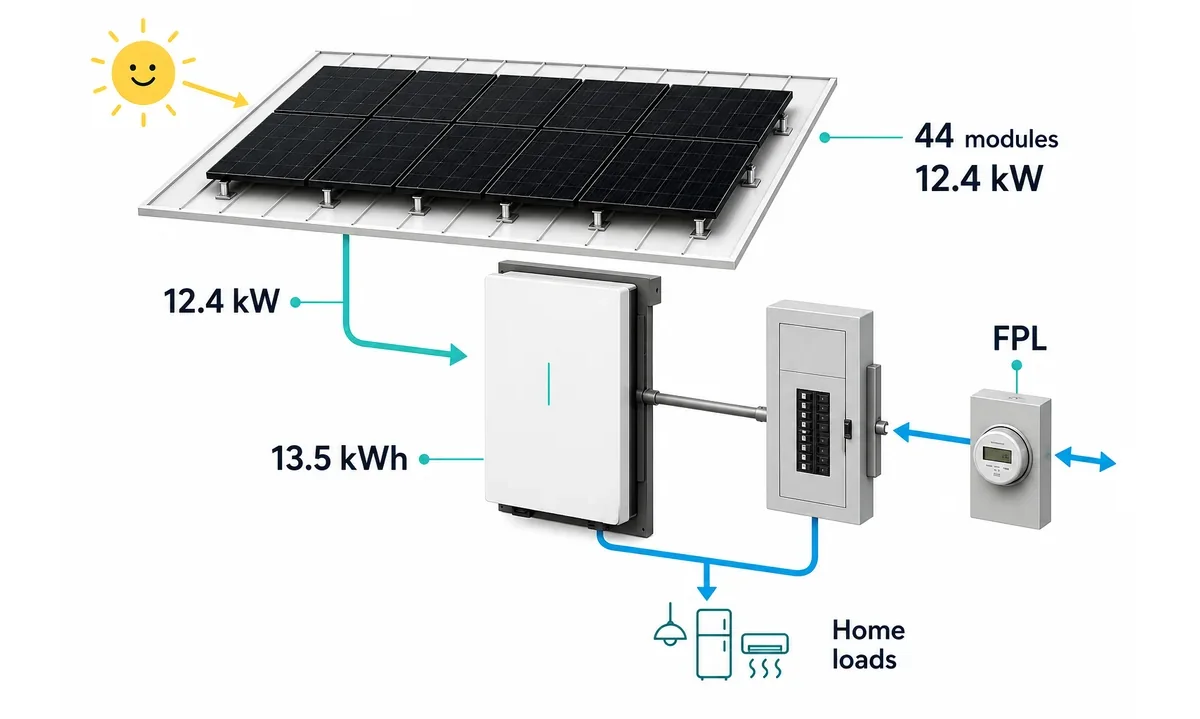
12.4 kW rooftop array in Weston, FL · 44 modules · standoffs anchored with stainless-steel bolts directly into the roof trusses.

At a glance

Project ledger

CountyBroward County
Permitting authorityWeston
Roof typeConcrete barrel tile
EnergizedSeptember 2016
Permit → energize56 days
System size12.4 kW
Modules44 panels
InverterIntegrated (Tesla Powerwall 3 built-in solar inverter)
BatteryTesla Powerwall 3 (13.5 kWh)
Annual production (est.)18,600 kWh
30-yr lifetime savings (est.)$132,735

Hardware

What was installed, and why.

  • Modules — 44× panels

    Mixed (original 2016 array + 2020 expansion). Sized to cover the home's 12-month baseline load with a minor buffer for future electrification.

  • Inverter — Integrated (Tesla Powerwall 3 built-in solar inverter)

    DC-coupled through the Powerwall 3's integrated 11.5 kW solar inverter. One device, one monitoring app, one fewer point of failure.

  • Battery — Tesla Powerwall 3

    13.5 kWh usable. Whole-home backup through grid outages, and time-of-use shifting when utility peak tariffs apply.

  • Racking — mounting system

    Standoffs anchored with stainless-steel bolts directly into the roof trusses

Equipment diagram showing the Weston solar system hardware and utility connection

Project timeline

How the Weston project moved from contract to meter.

A dated view of the work: contract, permitting, on-site installation, utility handoff, and any later expansion or battery phases.

01

Phase 1

Original install

July 11, 2016 to September 5, 2016

~8 weeks start to energized for the first system.

02

Phase 2

Expansion (2020)

2020

Added 3.8 kW of additional rooftop PV with Enphase microinverters alongside the original SolarEdge-inverted array, to cover rising household load (second EV, longer pool-pump run times, HVAC upgrades).

03

Phase 3

Re-roof + battery upgrade (December 2024)

December 2024

The underlying concrete tile roof and underlayment were due for refresh. We pulled all 44 panels, the SolarEdge string inverter, and the 2020 Enphase microinverters; the roofing crew refreshed the tile roof; and we then reinstalled the full 12.4 kW array on fresh underlayment and consolidated the electronics onto a single Tesla Powerwall 3 with 13.5 kWh of battery backup.

Total span
56 days contract to energized
vs. Florida average
~101 days · ~44% faster

Project notes

About the project

This Weston home holds a quiet but important distinction: it was the first solar project Sprightful ever installed in South Florida. Because this was a close family project, every design decision, every trip back to tune the system, every phase of expansion happened with the kind of unhurried, multi-decade horizon most solar companies never get to plan against.

Phase one kicked off in July 2016 and was energized by early September 2016 — about eight weeks, contract to meter flip. An 8.6 kW rooftop array sized to cover the household baseline load, mounted on standoffs bolted directly into the roof trusses with stainless-steel hardware — the South-Florida-grade approach, not the tile-hook clamps common in lower-wind regions — and paired with a SolarEdge string inverter plus per-module DC optimizers. It was state-of-the-art at the time, and it produced reliably for four years before the household's electrical appetite outgrew it — a second EV, a pool pump that ran longer in the summer, and a few more window-unit upgrades to central HVAC. In 2020 we came back and added 3.8 kW of rooftop PV using Enphase microinverters, bringing the total nameplate to 12.4 kW. The two subsystems ran side by side for four more years.

By 2024 the tile roof's underlayment — original to the home, already a decade older than the panels — was at the end of its service life. Rather than patch around the PV, we treated the re-roof as an opportunity to simplify the entire electrical stack. We pulled all 44 panels, the SolarEdge inverter, and the Enphase microinverters; coordinated the roofing crew to refresh the underlayment and reset the barrel tile; and then reinstalled the full 12.4 kW array on the fresh roof — this time routed directly into a single Tesla Powerwall 3. Because the Powerwall 3 ships with an integrated 11.5 kW solar inverter, the whole 12.4 kW array now runs through one DC-coupled device instead of two independent inverter platforms. Fewer points of failure, one monitoring app, better round-trip efficiency into the battery, and — for the first time in eight years — battery backup during hurricane-season outages.

The system has been running wonderfully since December 2024. My parents have watched the Powerwall ride the family through several FPL blinks and one multi-hour outage without so much as a flicker on the lights or the WiFi. It's the closest thing to a proof point we have that Sprightful's approach holds up over the long haul — not just the install, but the decade that follows it.

Why it matters

A 30-year financial and environmental decision.

These aren't projections pulled from thin air. FRCC eGRID emissions data, current FPL residential tariff, and modeled production under South Florida irradiance (~1,500 kWh/kW/yr).

18,600
kWh produced annually (estimated)
$132,735
30-year savings vs. staying on grid-only power
219tons
CO₂ offset over lifetime — equivalent to ~3,650 trees planted
Cumulative savings vs. grid-only30-year horizon
$0$66k$133k-$35kBreakeven · year 6Yr 0Yr 10Yr 20Yr 30

Good-faith estimates using FRCC eGRID emissions data, current FPL tariff, and Aurora-modeled production. Actual results vary with shading, weather, and future rate changes.

This testimonial is grounded in data and concrete facts about our experience stepping into the world of solar energy.

I share it freely so that each person can evaluate for themselves whether, when, and how to be part of this satisfaction of contributing a small grain of sand to caring for the environment — on top of the financial benefit, which is increasingly achievable thanks to the growth of the solar panel and energy storage industry.

A chronology of the experience:

2015 — Pablo, freshly graduated as an Industrial Engineer from UF, tells us that his passion and life's dream is to dedicate himself to solar energy.

2016 — We decide to become Sprightful Solar's very first customers, based on a clear financial proposition: a 30% federal tax credit, an 11-year estimated payback, a 25–30 year system life, minimal maintenance, 24/7 generation monitoring, and credit for excess energy sent back to the grid.

On top of that, Sprightful helped us optimize our electricity consumption by scheduling lower-cost windows to charge the Tesla, run the garden irrigation, and run the pool pump — and by installing a hybrid water heater. The first months were especially exciting: we were constantly checking the generation app, watching the peak production numbers, and learning how factors like the weather influenced them. So much fun!

2017 — The result was dramatic: our electric bill dropped from ~$600 in peak months down to approximately ~$100.

2020 — Thanks to the savings and a better-than-expected return, we decided to expand the system by installing more panels on the south side of the roof. The bi-directional meter let us draw on our accumulated energy to cover months of lower generation.

2024 — During our roof replacement, Sprightful efficiently coordinated with the roofing contractor to remove and reinstall the panels, ensuring proper waterproofing of the anchors before the tiles went back on.

In that same stage we also installed a Tesla Powerwall battery, which has been an excellent decision: beyond providing backup during outages, it automatically optimizes our usage — drawing from the battery during peak-rate hours, storing energy during the day, and pulling from the grid in cheaper time windows. It even anticipates adverse weather conditions. All intelligently managed!

2026 — Today I can attest that the Sprightful team continues to accompany and guide everyone interested in installing a photovoltaic system, always with a clear and responsible approach.

Congratulations on these 10 years!

Weston homeowner·Family review

More in Broward County

Nearby Sprightful installs.

Each AHJ has its own quirks — permit fees, setback rules, wind-load calcs. Here are similar projects we've run through the same county offices, close to Weston.

FAQ

Solar in Weston, FL.

How long does the solar permit process take in Weston?

Weston took 14 days from submittal to approval on this project. Typical range we've seen is 2–8 weeks depending on whether the roof assembly requires a secondary wind-load review.

What size solar system is typical for a Weston home?

Most Weston homeowners land between 8–16 kW — sized to offset 90–100% of their FPL bill. This project is 12.4 kW, on the standard end.

Does my HOA need to approve it?

Florida's Solar Rights Act (§163.04) prevents HOAs from outright banning rooftop solar. They can make reasonable aesthetic requests — we handle the HOA submittal directly and have a 100% approval rate to date.

What rebates and incentives are available in Broward County?

The 30% federal Investment Tax Credit (ITC) is the primary incentive — Florida has no state-level solar rebate. There's also no property tax increase for the added home value (Florida exemption), and no sales tax on the equipment.

Solar in Weston? Start with your roof.

Understand your roof's solar potential — no calls, no hassle, no obligation.